Your cart
There are no more items in your cart

ORIGIN
It may be very obvious, the main difference between Spanish and Iranian saffron is the origin, the place from which it comes is very important since in each saffron-producing geographical area there are different ways and methods of obtaining the spice, and Each change in the processes makes the resulting quality of the spice very different when comparing some samples with others.
ORGANOLEPTIC QUALITIES
The differences are noted, above all, in a chemical analysis of the spice where the organoleptic qualities such as Crocin (coloring component), Picocrocin (flavor component) and Safranal (aromatic component) are very different depending on where the saffron comes from. . There are also other parameters to take into account, although they are more technical, such as humidity or total ash.
VISUAL PROPERTIES
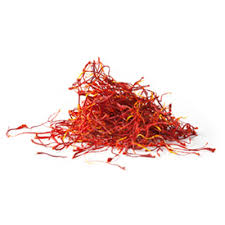
Visually there are also differences that can be observed if the product is analyzed carefully and knowing exactly what needs to be evaluated. To your left you can see a colored image of Spanish saffron
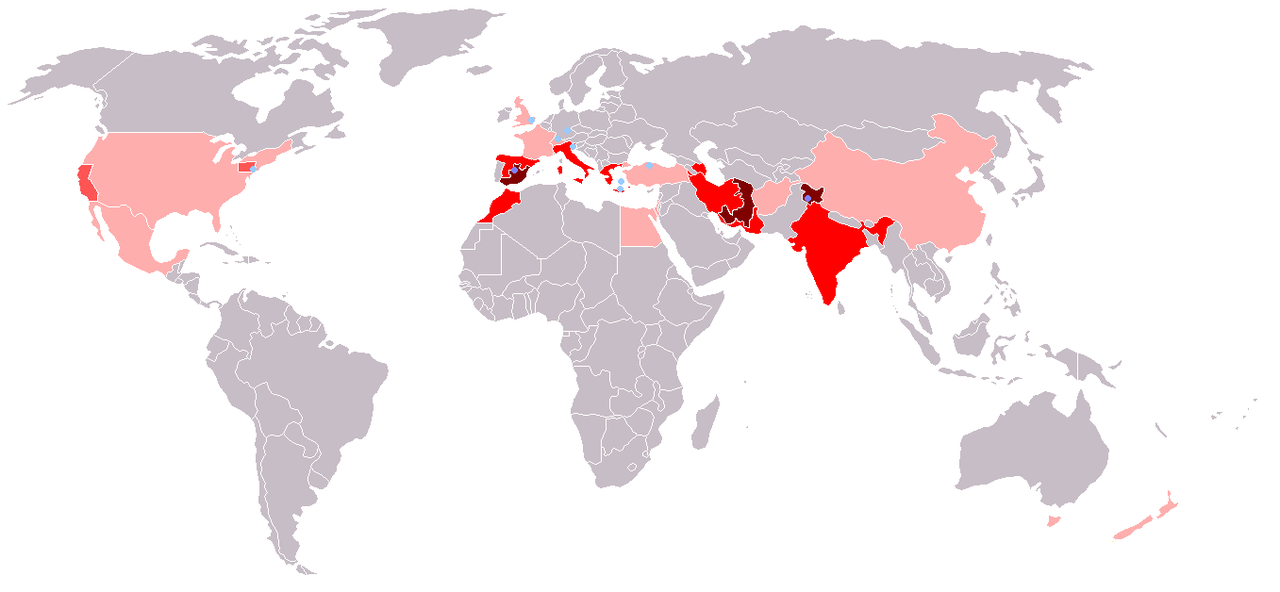
Currently, there are many countries where Saffron is produced. In terms of production, Iran stands out as the largest producer in the world with more than 90% of world production. In a second step would be Spain, with Aragon and Castilla La Mancha as the main production areas. production, Morocco, India, Afghanistan, Pakistan, Italy and Greece, in the third step there would be countries where saffron is produced on a token basis such as Switzerland, France, Argentina or some small area of the USA. In this post we are going to focus on two producing areas, Iran, which is the country that produces the most saffron worldwide, and Spain, which is where the best quality saffron in the world is produced. The differences are the following:
COST OF SAFFRON
In Spain the cost of production is much higher than in Iran, for several reasons, in Spain the production comes from family farms and through traditional and artisanal cultivation, for the work related to the saffron field, a tractor and equipment are used that cost a lot of money. and the work hours of the collectors and weeders are adequate for decent work. To your right you can see a colored image of Iranian saffron
iran strands In Iran there are different modes of production, there are farmers who have a small plot dedicated to cultivation, the means are very rudimentary and the flower they collect is sold in markets dedicated to this purpose, what they get for the flowers is laughable but it is The degree of poverty in which they live is such that it is the only means that provides them with something to survive, the packers who buy the flower and take advantage of the thankless effort of the farmer work very high margins, being able to offer a low price in the market and the treatment of the flower is very inadequate because the conditions of conservation of the flower, until the saffron is roasted, are not at all adequate, obtaining a final product of medium-low quality.
There are also large farms where the flower is obtained practically at no cost because the harvesting labor has a very low remuneration, the same thing happens with the weeders, the pay they get is miserable, these low remunerations make saffron much more economical than obtain that in countries where these habits would be considered labor exploitation
SAFFRON QUALITY
The best quality of saffron is always found in a new saffron from the calendar year after its harvest, worked in an artisanal way and with an appropriate dehydration process.
In Spain there is a great awareness of obtaining high quality saffron for two reasons, the first is that it is known that if a low quality saffron is obtained there is already another one on the market that is cheaper, so it would be like losing the saffron since it could not be sold, the second is the artisanal awareness of the family, as all the processes are carried out within the family from the conservation of the flower to the roasting process, the utmost care is taken to ensure that all the artisanal processing It is grown in the best conditions and every day to have the best saffron as a result.
In Iran, mainly due to the large amount of saffron that is produced, the processes cannot be as controlled, the flower is much more manipulated and moved until it is cleaned, this factor is the first that affects the quality of the saffron, If the flower is not very fresh, the cleaning process also becomes more complicated and the saffron blades are touched more than necessary and finally the roasting process, this is the most delicate and having such an amount of spice the processes are industrial. and the roasting is not uniform, the resulting saffron is darker and therefore has a lower coloring power, sometimes the saffron is left to roast in the sun, this is one of the worst ways to dry the spice because the resulting saffron It does not have a good power is its three main factors (Color, flavor and aroma)
BASIC DETAILS TO DISTINGUISH SPANISH SAFFRON FROM IRANIAN SAFFRON
- The Spanish saffron has the widest brin cup and the thickest body, normally the three brizns are joined by a white part (tail), that part is not saffron but it is a clear clue that it is Spanish saffron since the flower is there. cleaned by hand to obtain this type of production, the color of the saffron is red, the newer the saffron, the more intense the color
- Iranian saffron has both the brin cup and the body that are narrower and finer than the Spanish one. It is usually saffron (coupé) without white parts and with loose brines due to mechanical production work. The color of the saffron is dark red. and without intensity, this is due to drying by the sun or being dehydrated in large quantities and by ovens, in this case parts remain more toasted than others and the saffron that is not well toasted tends to darken more than necessary, if the Saffron is dark, it is a sign that the crocin (coloring power) is going to be low. sometimes